From War To Peace
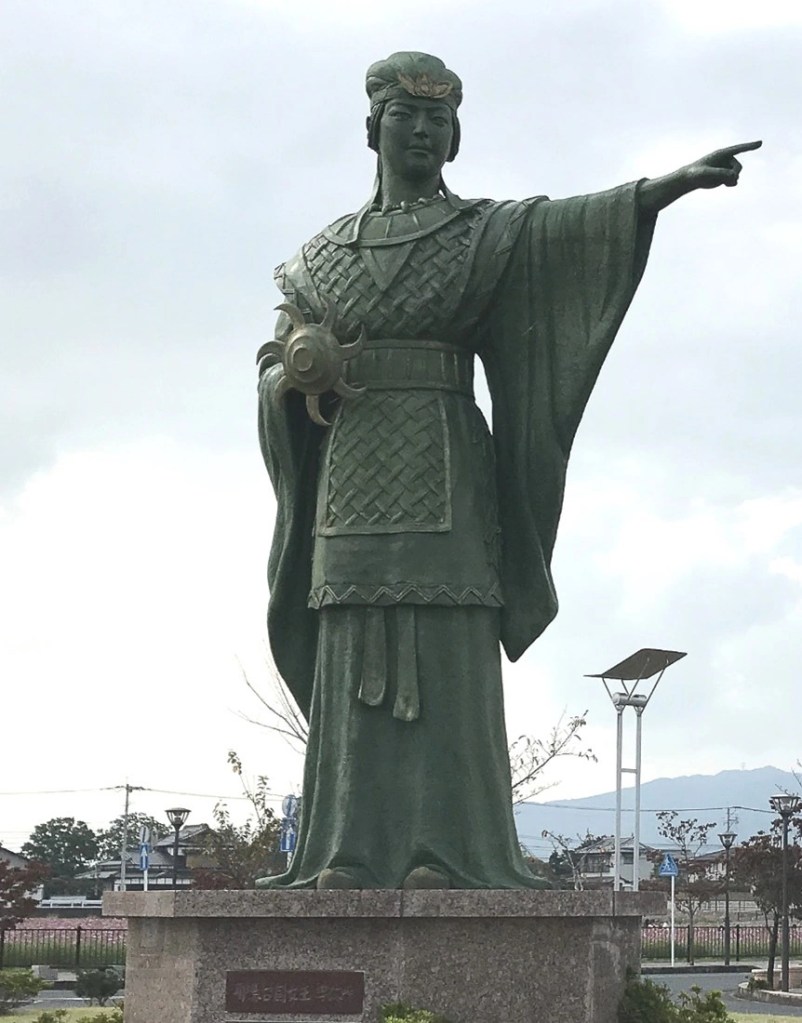
In c. 190 CE, a woman aged around 20 ascended to the throne of the ancient Kingdom of Yamatai in the Japanese Archipelago.1 The Kingdom of Yamatai was, in fact, a federation of smaller kingdoms that, in the 3rd century, banded together to elect a female Shaman, Himiko, as collective ruler, ending a period of prolonged warfare. Some 30 smaller kingdoms selected her, and as a result, she ushered in a period of long peace, until her eventual death in 248 CE.2 The archipelago is estimated to have housed between ½ a million and 4 million people during the time of her reign.3
The History of the Wei
We sadly know little of Himiko, her reign and the time in which she ruled. However, the Chinese Chronicle, History of the Wei (Wei Zhi; Gishi), whilst the only record of Himiko, offers us some glimpses into her rule. From the chronicle, we learn that a man had formally ruled the land, but after his death, his kingdom fell into some seventy to eighty years of disturbances and warfare, until Himiko was elected ruler.4 After her ascension, it’s recorded that few saw her, but that she had some one thousand female attendants and one man acting as a medium of communication. She also relied on her younger brother to support the ruling of the country.5 Some later historians have debated whether or not Himiko continued to exercise total power or if she relinquished said power to her brother, but it is often assumed she remained as the true ruler of the kingdom. We are also told that she occupied much of her time with magic and sorcery, bewitching people.6 It’s worth noting that shamanism for the age of Himiko was not systematically associated with an evil woman, but could be practised by both good and bad, and in the case of Himiko was perceived as good.


Legacy
However, when Himiko died in 248 CE, a man assumed the throne. Yet no one obeyed him, plunging the kingdom back into a period of assassinations and murders, seeing some more than one thousand people being slain. In the end, a relative of Himiko, the 13-year-old girl, Iyo, was elected queen, and order was restored.7 As for Himiko, the rest is quite literally history; we do not even know where she was entombed.
Her legacy has been two-fold, from her omission in the Japanese histories: The Records of Ancient Matters (Kojiki) and The Chronicles of Japan (Nihon Shoki), which both do not mention her to favour and consolidate the concept of a male-only line of succession.8 And even today, people are divided over her good and negative nature. With Ishinomori Shōtarō’s Manga, History of Japan (1997); Kobayashi Yoshinori’s manga, A New Theory of the Emperor (2010) & the film The Illusive Country of Yamatai, all depicting a positive view of Himiko as a great, commanding and religiously devout. Opposed to the negative discourse in Tomb Raider (2013) and Atlantica Online Role-Playing Game, Marvel Comic The Savage Sword of Conan The Barbarian (1992), and the film Himiko (1974), which depicts Himiko as sexually depraved, obsessed with power and authority, or a tyrant.
We may know little of Himiko, and yet she captivates our attention, simply because of the unknown.
Footnotes:
- Christopher Harding, The Japanese: A History in Twenty-Lives (Dublin: Penguin Books, 2022), 17. ↩︎
- Akiko Yoshie, Hitomi Tonomura, and Azumi Ann Takata, “Gendered Interpretations of Female Rule: The Case of Himiko, Ruler of Yamatai,” U.S.-Japan Women’s Journal, no. 44 (2013): 12. http://www.jstor.org/stable/42771843; Laura Miller, “Rebranding Himiko, the Shaman Queen of Ancient History,” Mechademia: Second Arc 9 (2014): 181. https://doi.org/10.5749/mech.9.2014.0179; Harding, The Japanese, 19-20. ↩︎
- Harding, The Japanese, p. 16. ↩︎
- Yoshie, “Gendered Interpretations of Female Rule,” 7. ↩︎
- Yoshie, “Gendered Interpretations of Female Rule,” 7. ↩︎
- Yoshie, “Gendered Interpretations of Female Rule,” 7. ↩︎
- Yoshie, “Gendered Interpretations of Female Rule,” 13. ↩︎
- Yoshie, “Gendered Interpretations of Female Rule,” 6. ↩︎
For further resources, refer to the Comprehensive Bibliography.
 Asian Queenship