From nothing
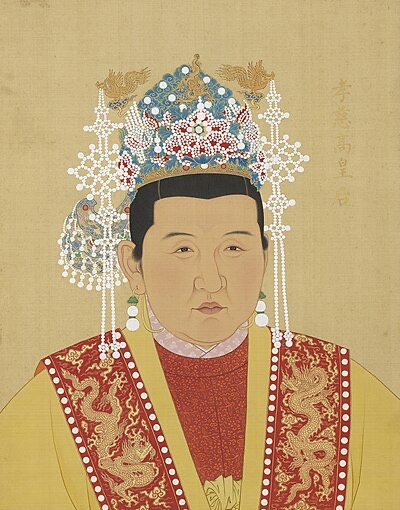
By the mid-fourteenth century, the once-powerful Yuan (Mongol) Dynasty (1206-1368), after a series of natural disasters – the flooding of the Yellow River and famines – political turmoil and internal power struggles was on the verge of collapse. By 1351, the empire was engulfed in rebellion, one the Yuan Dynasty could not quell. From the flames, the most unlikely contender to usher in a new order was Zhu Yuanzhong (1328-1398). He started life as a poor peasant orphan who eventually turned rebel. Upon meeting and gaining favour with the educated gentry. He transitioned from a low-life rebel warlord to an influential leader and contender for the throne.1 During these years, he made acquaintance with Guo Zixing (a fellow rebel leader), who happened to be the adoptive parent to Ma Xiuying (1332-1382)(left image). Much of her early life is a mystery. Still, we know that sometime during her early years, both her parents died, and she was taken in by Guo Zixing, who raised her as his own.2 Guo Zixing, realising how promising Zhu Yuanzhong was, offered his daughter in marriage. The two married in 1332, a year after the start of the Red Turban Rebellion (1351-1368), which would see Zhu Yuanzhong overthrow the Yuan Dynasty. It was during these rough years of war, that Zhu Yuanzhong and Ma Xiuying became a formidable unit.
The virtues of an empress
In 1368, after 17 years of war, Zhu Yuanzhong and the Red Turban Rebellion succeeded in overthrowing the Yuan Dynasty. Zhu Yuanzhong ascended to the throne and was decreed Hongwu Huángdì 皇帝 (Emperor), as he ushered in the Ming Dynasty (1368-1644). A month later, he declared his wife Ma, Huánghòu 皇后 (Empress). Whilst we do not know much of Ma’s life as consort, we are informed extensively of her virtues and the precedent she set for later imperial women. In the History of the Ming, she is described as ‘kind-hearted and merciful, wise and discriminating, and fond of learned books.’3 Ma also oversaw Hongwu’s official documents and communications during the predynastic period.4 Her role as wife knew no bounds, and whilst she remained reserved about interfering outright in political matters, her influence over her husband and Hongwu’s acceptance of her advice was significant. As a result, she was often compared to the wife of Taizing Huángdì of Tang (r. 598-649), Zhangsun Huánghòu (601-636), who, like Ma, enjoyed reading, refrained from interfering in political matters but who also stood beside armies when needed. Equally, due to her poor upbringing, Ma remained frugal throughout her time in the imperial palace; even when her clothes became worn and needed replacement, she would refuse to change them.5 And even during the years of the rebellion, she personally made clothing and shoes for the soldiers in aid of the army.6 Ma was painted as a paragon of queenship and as an exceptional wife, setting the expectations of consorts and women to follow.
A merciful heart
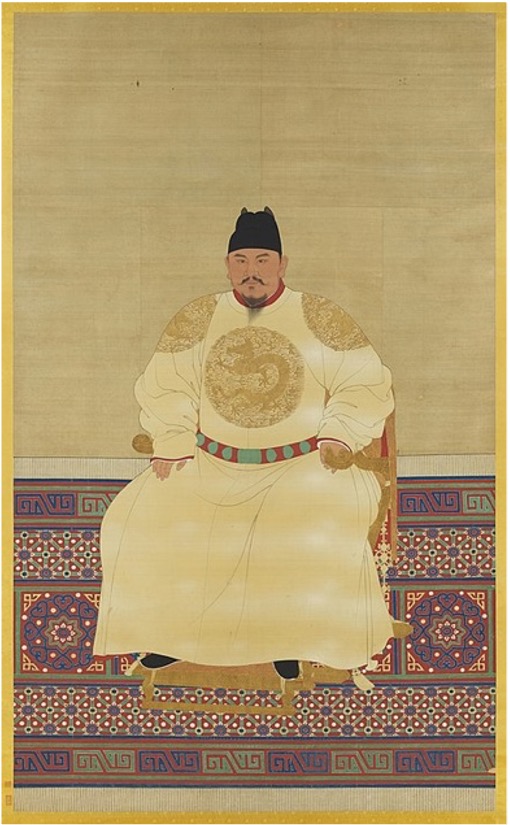
As Hongwu’s reign continued, he became paranoid of betrayal and rebellion, fearing a fate similar to that of the Yuan Dynasty. As a result, he was often hot-tempered and harsh in his punishments, usually not waiting to review the facts or determine the credibility of accusations. Ma, on the other hand, was the opposite, often acting as the voice of reason behind closed doors, where she persuaded Hongwu to apply less severe punishments. One such example was when Yang Xian falsely accused the garrison commander Li Wenzhong of illegal activities. Without proof, Hongwu (left image) demanded Li Wenzhong back to court, but Ma reminded Hongwu that the commander was garrisoned on the enemy frontier and what risks would arise in such a rash decision. She also urged him to remember what good character Li Wenzhong possessed. Hongwu, on the advice of Ma, left Li Wenzhong garrisoned in Zhejiang, where he proved to be a loyal subject.7 Another example was Song Lian, who was sentenced to death due to a crime committed by his grandson. Ma again made a plea to Hongwu by refusing to take meat or liquor. Hongwu was so outraged by her act, that supposedly he threw down his chopsticks and left her company. However, the following day, he rescinded his order for Song Lian to be executed and instead exiled him.8 Ma was credited with being Hongwu’s level head and ensuring that he did not go too far in punishments as to cause opposition to his rule.
Legacy
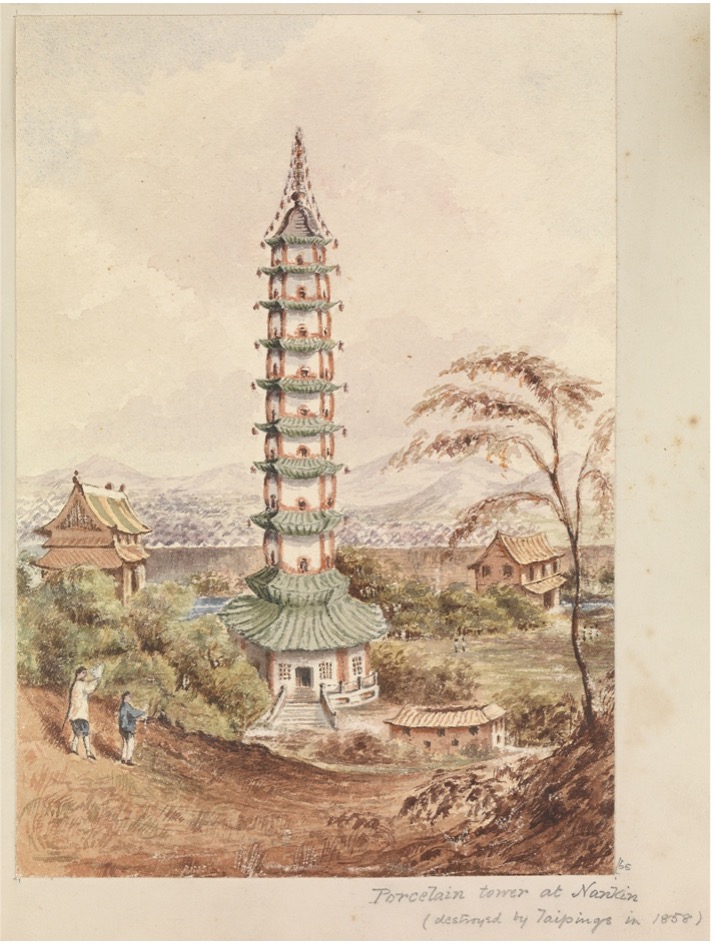
Ma had stood beside Hongwu for most of his life, but in September 1382, Ma was stricken with illness. She refused doctors, concerned that if they failed to prolong her life, they would be punished as a result.9 Not long after, in the same month, she died at the age of fifty-one. Hongwu became visibly distraught at the passing of his wife and longtime companion, that he never bestowed the title or honour of Huánghòu to any other women in his remaining sixteen-years. But, eventually in 1398, the first Ming Huángdì would die, ushering in a period of civil war for four years, that threatened the continuation of the Dynasty. Eventually, Zhu Di (1360-1424), one of Honhwu’s sons, and later Yongle Huángdì (r. 1402-1424), seized the throne, restoring order to the empire. He asserted that he was the son of Ma to consolidate his right to the throne, given that only children born of the primary wife were legitimate claimants to the throne. However, it is likely that Ma never had any children which posed the risk of the dynasty collapsing.10 Yongle proved his devotion to her by constructing the Porcelain Pagoda (right image), which he dedicated to her as a lasting motif of her prominence in the supporting of the Ming Dynasty.11 Similarly, his wife Xu Háunghòu (1362-1407) also claimed a connection to the famed Ma, highlighting that she had been one of her ladies and had been taught by Ma of her womanly virtues. These would eventually, as stated by Xu, be the very lessons she wrote in the Teachings of the inner court (neixun), where she aimed to pass on the advice she had once received.12 The text would be central to women’s lives inside the court and sustained the legacy of Ma as a paragon of queenship.
Footnotes:
- John Keay, China: A History (London: Harper Press, 2009), 371. ↩︎
- F. W. Mote, Imperial China 900-1800 (London: Harvard University Press, 2015), 550. ↩︎
- Keith McMahon, Celestial Women: Imperial Wives and Concubines in China from Song to Qing (London: Rowman & Littlefield, 2020), 83. ↩︎
- Zhang Tingyu et al., ‘Empresses of the Ming Dynasty: 1368-1462,’ Renditions no. 85 (Spring 2016), trans. Ellen Soulliere: 29. ↩︎
- McMahon, Celestial Women, 83-84. ↩︎
- Tingyu et al., ‘Empresses of the Ming Dynasty,’ 29. ↩︎
- Tingyu et al., ‘Empresses of the Ming Dynasty,’ 30-31. ↩︎
- Tingyu et al., ‘Empresses of the Ming Dynasty,’ 31; Wilt Idema and Beata Grant, The Red Brush: Writing Women of Imperial China (London: Harvard University Press, 2004), 623. ↩︎
- McMahon, Celestial Women, 84. ↩︎
- Mote, Imperial China, 594 & 618. ↩︎
- McMahon, Celestial Women, 88-89 ↩︎
- Idema and Grant, The Red Brush, 308-309.
For a translation of The Teachings of the Inner Court, see Ann A. Pang-White, The Confucian Four Books for Women: A New Translation of the Nü Sishu and the Commentary of Wang Xiang (Oxford: Oxford University Press, 2018). ↩︎
For further resources, refer to the Comprehensive Bibliography.
 Asian Queenship