
Women Rule Returned
Born in 1623 CE to Go Mizunno Ten’nō 天王 (emperor) and Kazuko Chūgū 中宮(Empress), Meishō was the first of five daughters and two sons, of which only Meishō and two of her sisters would survive past infancy.1 The world Meishō entered was complex, with the Imperial household depicting power and divine authority, whilst the Tokugawa Shogunate (a warlord dynasty) officially held authority. It was the marriage between Go Mizunno and Kazuko that officially united the two households, with Kazuko’s father, Hidetada (the shogun), arranging the marriage. This marriage offered greater leverage to the shogunate to control the royal household. However, in 1629 CE, Go Mizunno made an unexpected move by abdicating, leaving his five-year-old daughter on the throne. His abdication was a result of continuous encroachments on his power and authority. Whilst the name Meishō is used throughout this piece, her birthname was in fact Okiko, only changing to Meishō in 1629 CE when she became the ruler. The decision to call her Meishō derived from the ending of two previous female rulers names in Japan’s history, Gemmei (r. 708-714 CE) and Genshō (r. 715-724 CE), who both ruled as Ten’no’s of their day and acted as a form of legitimisation to a woman’s sudden return to power.
A place holder
Whilst Japan does indeed have a history of powerful and influential female Ten’no’s, Meishō is unfortunately not one. Due to her age, when she ascended to the throne, she was too young to take over the court and government officially, and so scholar-minister Fujiwara Katentō served as acting regent on her behalf.2 Her rule only lasted fourteen years, over which she exercised very little power. It’s worth noting, as highlighted by Ben-Ami Shillony, that this was not singular to Meishō but was instead shared with her male counterparts of the time.3 Additionally, throughout her life Meishō never married or had children, with many now assuming that this was a bi-product of her parents who influenced her not to throughout her years on the throne to ensure a smooth succession to her nephew. Meishō’s rule, however, did witness one major event, the 1637 CE Shimabara Rebellion. The peasantry-led rebellion opposed the continued high taxation after several years of bad harvests. The uprising was eventually crushed, with some 37,000 rebels killed, and the Shogun’s decision to ban Christianity also witnessed him expel nearly all foreigners in the country. But despite this, Meishō appears not to have had any dealings with the government response, in the eyes of her court, she was a simple placeholder as they waited for a male heir to come of age to take over. In 1643 CE, at the age of 20, the time arose when many, including her parents, persuaded Meishō to finally step down and abdicate in favour of her thirteen-year-old nephew, Go Momozono.
Retirement
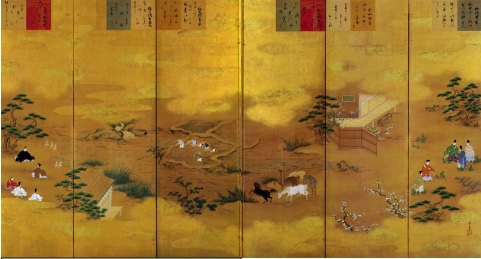
After Meisho’s abdication in 1643 CE, she took up Buddhist vows and is associated explicitly with the Tendai temple of Jūzenji in Yamashina. Her later life was full of religious devotion and artistic endeavours, both personally and through gifts (such the Scenes of the Twelve Months, to the right, gifted to Meishō by her brother, Reigen). In 1655 CE, she even commissioned the two-storied pavilion at Jūzenji.4 As highlighted by Akira Tanaka, Meishō also visited the Kawara Imperial Villa in her final years, where she partook in leisure activities such as watching actors perform typical roles such as farming and fishing.5 In addition to this, it’s noted that Meishō took enjoyment in watching passers-by from a window, similar to her father. In contrast to the relaxed activities listed, Meishō and her parents also held gatherings to which other members of the imperial family and friends were invited, including but not limited to the performance of poetry, music and dance, and incense appreciation.6 However, in 1696 CE, Meishō would eventually pass away at the age of seventy-three, along with most of her memory. She is rarely maintained in the record, and only one other female ruler would follow her in the eighteenth century, Go Sakuramachi Ten’nō. The return of female rule was brief and was perceived solely as a temporary measure whilst the search for a male ruler was conducted, which stood in contrast to their much earlier counterparts in the Nara Period who were anything, placeholders.
Footnotes:
- Ben-Ami Shillony, Enigma of the Emperors: Sacred Subservience in Japanese History (Kent: Global Oriental, 2005), 98. ↩︎
- Michiko Y Aoki, “Jitō Tennō: The Female Sovereign,” in Heroic with Grace: Legendary, 75.
Women of Japan, ed. Chieko Irie Mulhern (Oxon: Routledge, 1991), 75. ↩︎ - Shillony, Enigma of the Emperors, 99. ↩︎
- Elizabeth Lillehoj, “Empress Meishō (1623-96) and Cultural Pursuits at the Japanese Imperial Court,” Asia Pacific Perspectives Vol 12, Issue 1 (2013): 13. ↩︎
- Akira Tanaka, “Leisure Activities at the Kawara Imperial Villa of Retired Empress Meishō: Through Comparison with the Shugakuin Imperial Villa,” Intercultural Understanding Vol 1 (2011): 75. ↩︎
- Lillehoj, “Empress Meishō,” 19. ↩︎
For further resources, refer to the Comprehensive Bibliography.
 Asian Queenship