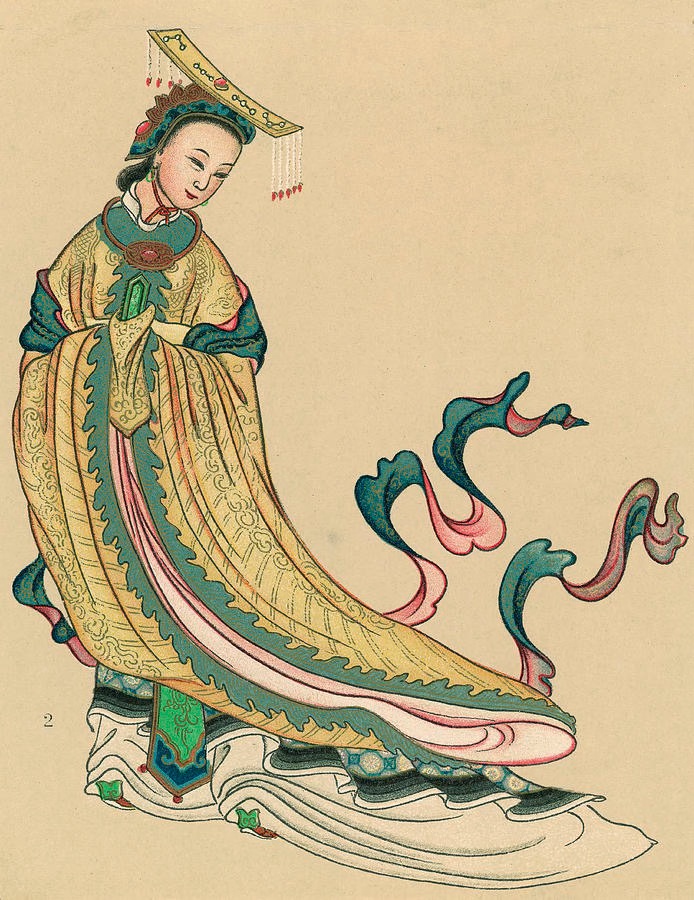
‘Hens should not announce the dawn’1
A classical Chinese Confucian proverbial that justified the omission of women in positions of power in East Asian History. Yet, in the seventh century, despite the opposition to female rule, Tang China (617-907 CE) bore witness to the first and sole female Huángdì 皇帝 (Emperor) in over 2,000 years of its imperial rule, her name, Wu Zetian. The legacy of her rule by successive dynasties such as the Song (907-1279 CE) and Ming (1368-1644 CE) casted Wu as a usurper and anti-worthy who had slept and murdered her way to power, bringing China close to calamity. However, her indirect rule for half a century and direct rule of fifteen years saw her lead China during its golden age where trade and commerce flourished, the patronage of Buddhism was unparalleled, and women given the chance to officially join the court.
‘The Fair Flatterer’
Born in c.625 CE to Wu Shiyue and Lady Yang, Wu Zetian was expected to be nothing more than another subordinate to the patriarchal regime in which she found herself. By age 14, she had been summoned to the court of Taizong Huángdì (r. 626-649 CE). When she arrived at court becoming one of Taizong’s 122 concubines, she was rewarded the nickname ‘the fair flatterer,’ to symbolise her beauty.2 Concubines of any rank are the defecto wife of the ruler, even if they have not officially laid with one another,3 and so whilst historians today question if Taizong and Wu ever had a sexual relationship, they were by tradition and practice a unit. Thus, when Taizong’s son Gaozong and Wu started to have an intimate relationship, they had in fact committed incest despite not offically being related. But their love affair came to an end when the Taizong finally perished in 649 CE, resulting in all 122 concubines being carted off to nunneries. By all odds, Wu’s story should have fallen into mystery, and her memory stripped from the record. However, when she was summoned back to court in 651 CE, the fate of the Dynasty and China as a whole changed course.
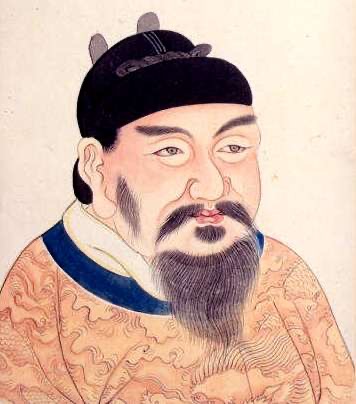
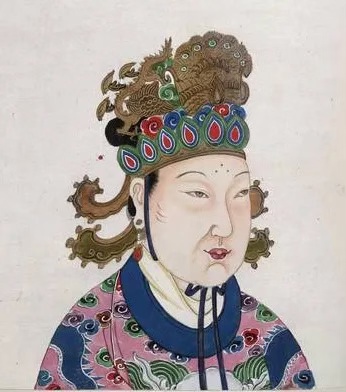
‘Wu is a treacherous fox, who has bewitched the emperor and now sits on the throne. I hope I shall be reborn a cat and … Wu as a rat, that I may bite out her throat’4
Wang Huánghoù 皇后 (empress), the main wife of the then ruler Gaozong, had in her two years upon the throne from 649-651 CE, failed to provide the ever-necessary male heir that would secure her position. However, when Gaozong’s honoured concubine Xiao succeed in producing a male heir, Wang’s position at court became tenuous. As a result, in a bid to by herself time, she persuaded Gaozong to to summon his old love, Wu Zetian back to court. Wang’s plan initially was met with much success, Gaozong pushed Xiao aside, and became enamoured with Wu, so much so that Wu would have her first child, a daughter, in 654 CE. Wang’s early successes however were quickly undermined, when Wu’s daughter was murdered, and both Wang and Xiao were blamed. The accusations soon escalated to include sorcery and the two were placed under arrest inside the imperial palace.5 With both Wang and Xiao removed from the court, Wu and Gaozong moved to have Wu positioned as Huánghoù. But key officials, Zhangsun-Wuji (maternal uncle of Goazong) and minister Dengshan opposed such measures, believing that Wang was still the better match. Yet, despite their opposition, Gaozong would crown Wu his wife. Wang and Xiao however, still clung to the belief that Gaozong would save them, and so after a direct attempt to influence him, and nearly succeeding, Wu decisively ordered for them to be dragged from their confines. She then had them whipped, their hands and feet removed and their bodies drowned in vats of wine.6 This was a clear message not only to Gaozong that she would not surrender her chance to sit on the throne but also to court officials who dared to challenge her.
‘The Two Sages’
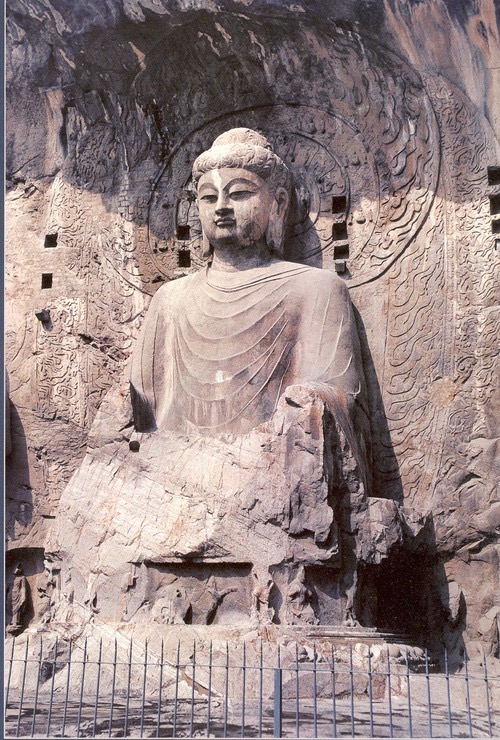
Between 654 CE and 660 CE, Wu and Gaozong ruled cordially and harmoniously. It was during this time that both patronised the Longmen Grottoes, in which Wu ordered the erection of the Grand Vairocana Buddha (figure to the right), of which she donated twenty thousand strings of her own money.7 But when in 660 CE, Gaozong suffered the first of serval strokes, Wu was entrusted with overseeing the court. Those who had once opposed her, such as Minister Dengshan and Zhangsun-Wuji, quickly fell from power, being banished from court and exiled to remote parts of the country, where they were forced to commit suicide. When Gaozong returned to health, he attempted to remove the power Wu had gained but was quickly blocked. Instead, due to Wu’s newfound authority, the two were co-ordained as the Two Sages – which, in effect, labelled them as equals. This was furthered when, in 666, Wu pushed for the Shen and Fang ritual to be celebrated and succeeded. The Sheng and Fang ritual, was only done at times of great prosperity and had not been performed since the Han Dynasty.8 With the approval of its occurrence, Wu furthered her campaign, seeing women’s participation in the ritual for the first time. Shortly following the ritual, it was discovered that Wu’s niece, the Lady of Wei, had become pregnant with none other than Gazong’s child.9 At a feast, in front of Gaozong, Wu had her niece poisoned and her cousins framed. Following this, Wu’s expansion of power over Gaozong (until he died in 683 CE) and the court continued until she eventually deposed her second son Ruizong in 690 CE to declare herself Hunagdi.
‘The Maitreya, Peerless, Golden Wheel, Divine and Holy Emperor’10
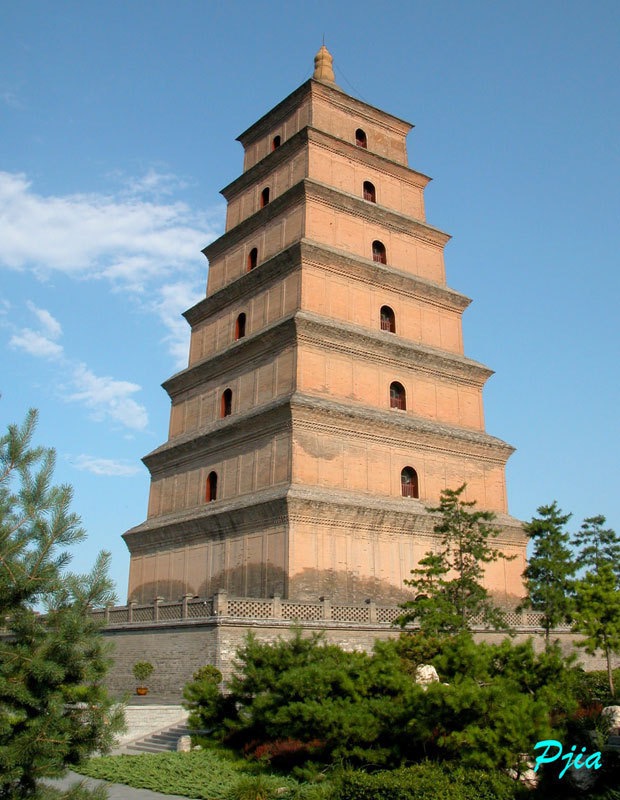
Wu’s regency over both her sons was short-lived, as she grew tired of acting through them, and in 690 CE, Wu declared herself Huángdì of all China. Her next 15 years on the throne saw the defeat of rebellions, a patronage regime of Buddhism like never before, the elevation of women to positions of power and her own three lovers trying to gain unyielding authority. Wu’s patronage of Buddhism witnessed the construction of the Ancient Mingtian twice (after the first was burnt down), the erection of the tallest pagoda of her day, the Giant Wild Goose Pagoda (image to the left), as well as the translation and distribution of the Avatamsaka Sutra and Great Cloud Sutra with the support of her Buddhist teacher and confidant Fazang.11 Her reign also saw Shangguan Wan’er rise to prominence from being sold into slavery to the Prime Minister of Wu’s court and later concubine to Zhongzong.12 However, her three lovers would eventually unravel her hold on power. The first she removed with little harm to her image, but the Zhang brothers and their monopolisation of power for their family during Wu’s final years would eventually spark a rebellion against which the living goddess could not win.13 In February 705 CE, guards stormed her palace with the aim of removing her from power; however, in one last act of control, Wu abdicated in favour of her son Zhongzong. She was forced to retire from the court, and months later, she would finally pass.
‘The Lord of Perfect Satisfaction’
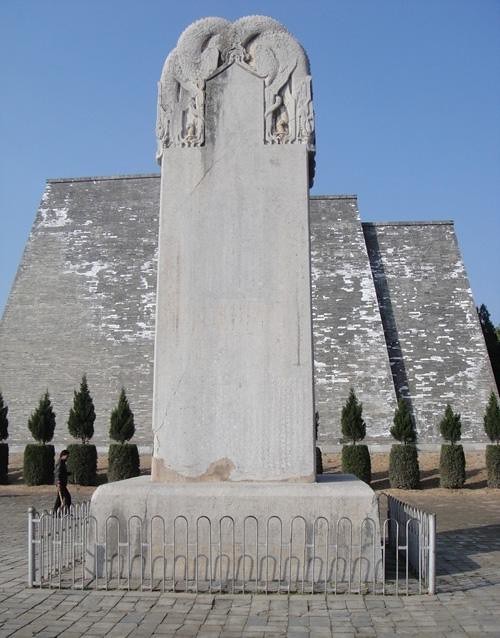
Residing in the Tang Mausoleum is a stele void of any inscription – the tomb stele of Wu Zetian (image to the right). Historians have debated whether this was a way of writing her out of history or a final act on her part to show that she needed no mortal word to remember her contribution to the empire. But whilst the two books of Tang do not outwardly mass criticise Wu’s reign, the Song dynasty painted her as an anti-worthy to avoid, which saw Liu Huánghoù (969 – 1033 CE) advised to surrender the throne to her son.14 In the Ming Dynasty, through the publication of the erotica The Lord of Perfect Satisfaction, Wu was portrayed as a sexual harlot who allowed her own desires to misguide the natural order.15 It is only in recent decades that Wu’s anti-worthy legacy and narrative has been challenged and re-assessed. Now depicting her as an ambitious, cunning and devotional woman and ruler, which not only saw her ascend to the dragon throne, but also reside over one of China’s golden ages.
From concubine to a living God.
Footnotes:
- The Book of Documents, trans. James Legge at https://chinesenotes.com/shangshu.html, Zhou She – Speach at Mu. ↩︎
- Johnathan Clements, Wu: The Chinese Empress who schemed, seduced, and murdered her way to become a living God (London: Albert Bridge Books, 2014), 24. ↩︎
- Keith McMahon, “The Institution of Polygamy in the Chinese Imperial Palace,” The Journal of Asian Studies 72, no. 4 (2013): 917–36. http://www.jstor.org/stable/43553235. ↩︎
- Clements, Wu, 76. ↩︎
- Keith McMahon, Women Shall Not Rule: Imperial Wives and Concubines in China from the Han to Liao (London: Rowman & Littlefield, 2013), 188-190. ↩︎
- McMahon, Women Shall Not Rule, 188-190. ↩︎
- Jinhua Chen, “More than a Philosopher: Fazang (643-712) As a Politician and Miracle Worker,” History of Religions 42, no. 4 (2003): 320-58. ↩︎
- David Sevillano-López, “The construction and use of the Mingtang by Empress Wu Zetian,” Antesteria No7 (2018): 304. ↩︎
- Clements, Wu, 108. ↩︎
- Heping Liu, “Empress Liu’s ‘Icon of Maitreya’: Portraiture and Privacy at the Early Song Court.” Artibus Asiae 63, no. 2 (2003): 142. http://www.jstor.org/stable/3249683. ↩︎
- Chen, “More than a Philosopher,” 320-58. ↩︎
- Wilt Idema and Beata Grant, The Red Brush: Writing Women of Imperial China (London: Harvard University Press, 2004), 61-72. ↩︎
- McMahon, Women Shall Not Rule, 194-198. ↩︎
- John Chaffee, “The Rise and Regency of Empress Liu (969—1033),” Journal of Song-Yuan Studies, no. 31 (2001): 19. http://www.jstor.org/stable/23496088. ↩︎
- Charles R. Stone, The Fountainhead of Chinese Erotica: The Lord of Perfect Satisfaction (Ruyijun Zhuan), with a Translation and Critical Edition. Honolulu: University of Hawai’i Press, 1997. ↩︎
For further resources, refer to the Comprehensive Bibliography.
 Asian Queenship